Part 1 covered who owns which layer and how each company pays for it. Applied Digital owns two layers and rents them out. IREN owns all six. Nebius owns most of them. CoreWeave rents the bottom two and owns everything above. That map explains most of the financial results below.
Where each one stands and where they finish the year
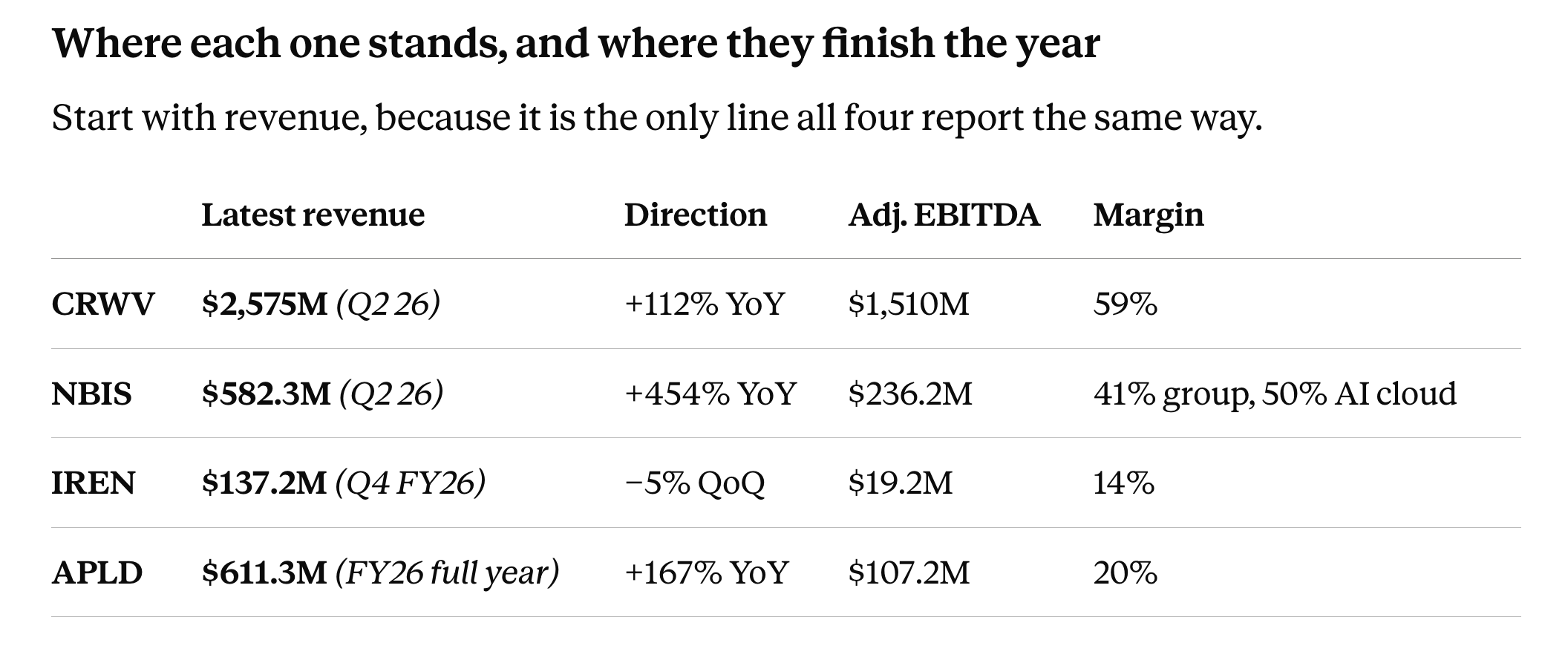
CoreWeave has posted $1,212M, $1,365M, $1,572M, $2,078M and $2,575M across five quarters with no sequential decline. It’s full year guide is between $12.4 to $13.2 billion for 2026. If you back out the first half and the Q3 guide, the implied fourth quarter is $4.1 to $5.1 billion. This means QoQ growth is running at 24%, 37%, and 31%. Its exit run rate is $18.5 to $19.5 billion. The company added about 500 megawatts of active power in Q2, with 300 of those arriving in June.
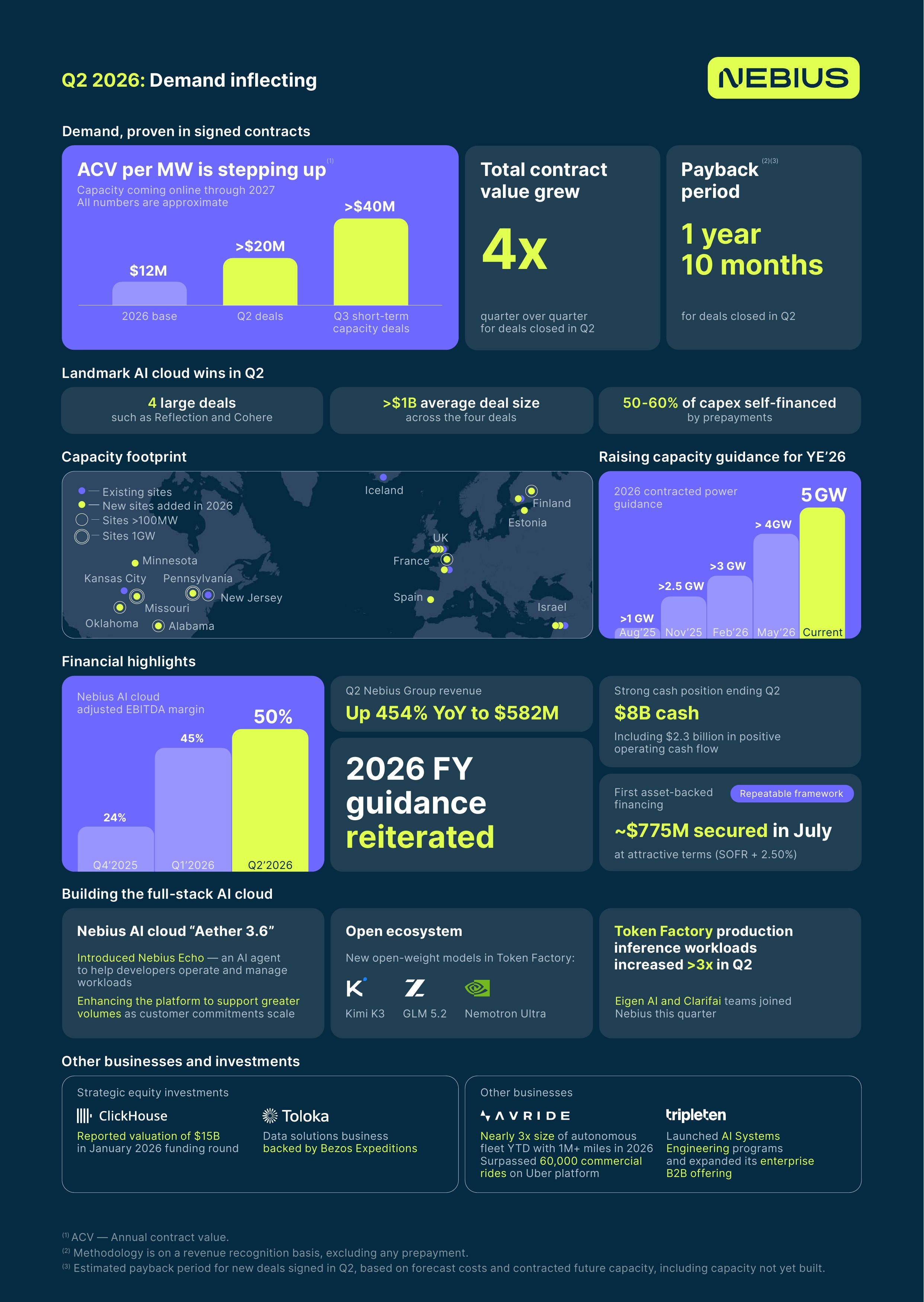
Nebius grew 454% year over year. It guides to $3.0 to $3.4 billion for 2026 with an exit run rate of $7 to $9 billion. It booked $981.3 million in the first half of the year, so the second needs to deliver $2.0 to $2.4 billion. The company is now at the point where signed contracts are becoming invoices. So far it is working, and sales grew roughly fourfold in the quarter, four separate deals over $1 billion each, and the AI cloud business has a 50% adjusted EBITDA margin. Now the company has to continue to execute at this pace.
IREN is the only company with declining revenue, which is from this long bitcoin to AI compute transition. Revenue fell $7.6 million sequentially as bitcoin miners were swapped out for AI GPUs. AI cloud revenue doubled during the quarter to $70.5 million. Meanwhile, mining revenue fell to $66.7 million and $638.8 million of hardware was written off. Adjusted EBITDA has fallen for five straight quarters, from $121.9 million down to $19.2 million. The next big event is Horizons 2 - 4 landing in Q4 2026, with revenue arriving mostly in the March 2027 quarter.
Applied Digital reported revenue up 407% to $258.7 million in its May quarter, but $152.4 million of the $203.0 million HPC line was one-time tenant fit-out billed at construction margins. Recurring base rent was $44.1 million and full-year NOI was $90.4 million.
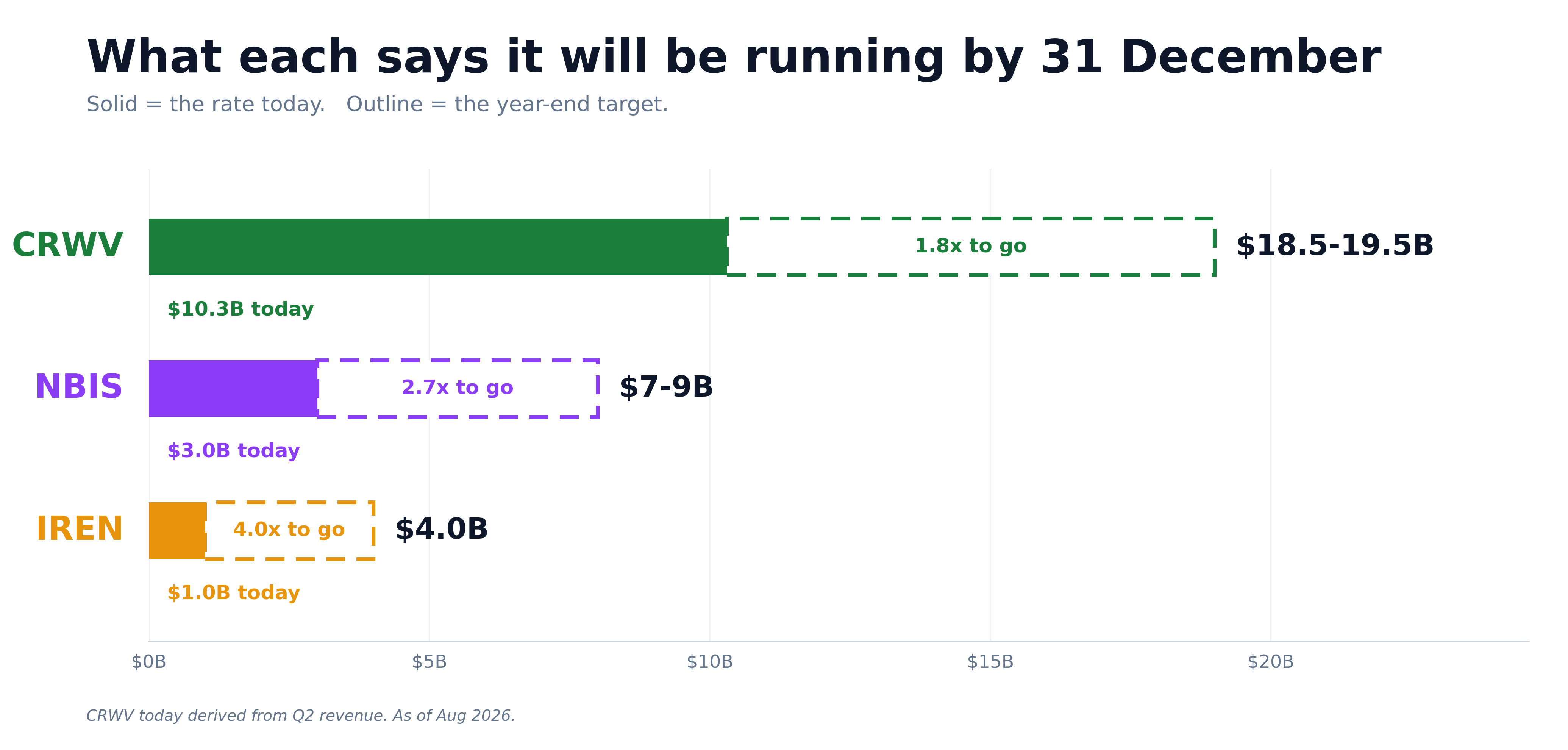
Compared to where they are today, these compute sales targets are all ambitious. CoreWeave is at roughly $10.3 billion on Q2 revenue annualized, so it needs to essentially double. Nebius is at $3.0 billion and needs to nearly triple. IREN is at $1.0 billion and needs to quadruple. Applied Digital publishes no run rate, only NOI, which is why it is not on the chart. How they can do it is by the rising price of AI compute.
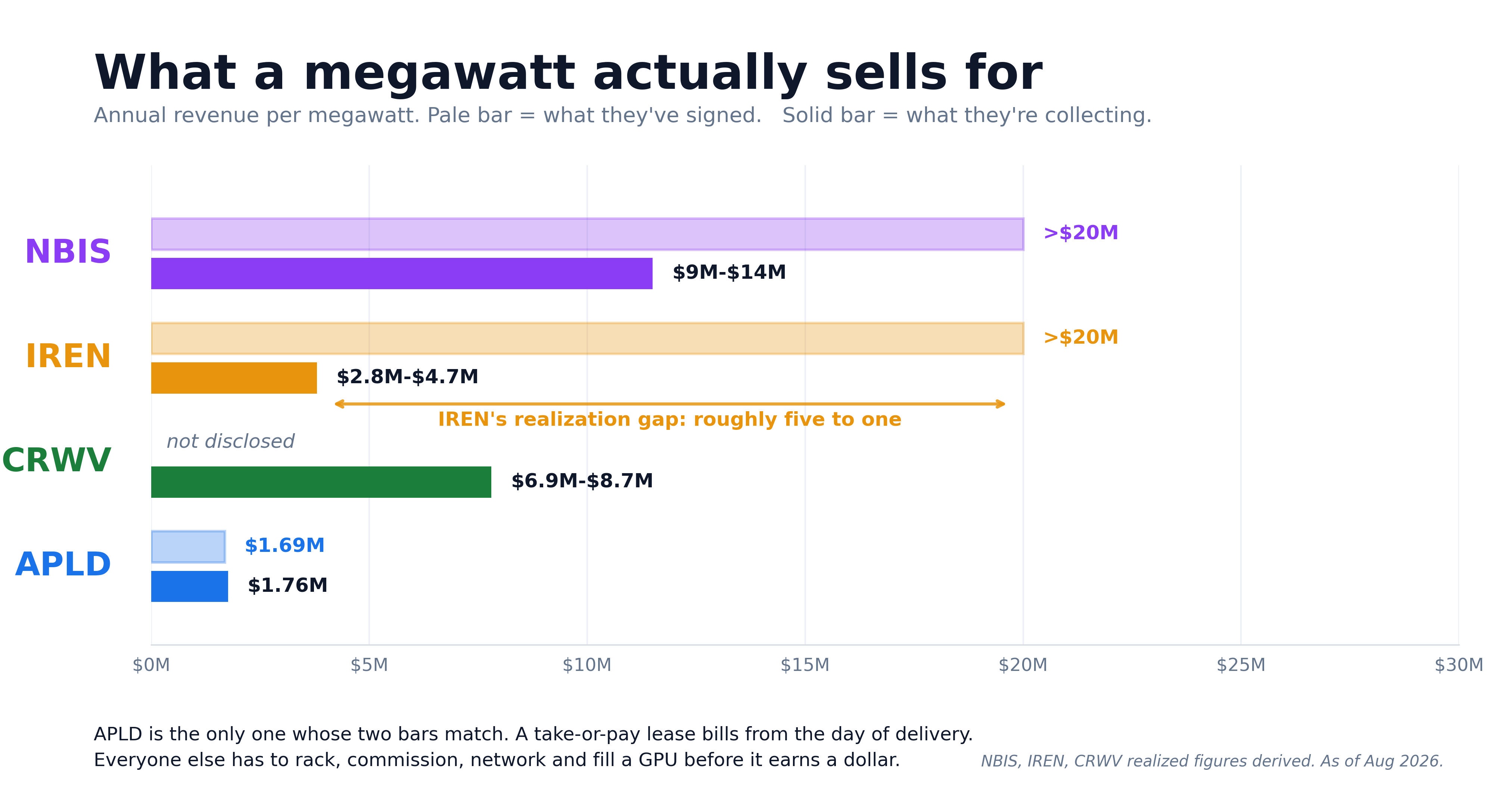
Nebius currently bills between $9 million and $14 million dollars, with $12 million average. They are signing new deals at over $20 million dollars per megawatt. Q2 deals closed at $20 to $25 million, and the first short-term deal, signed in early Q3, priced above $40 million. Compute prices are rising rapidly, while also delivering new capacity quickly. Nebius raised prices on older-generation GPUs by more than 30% over Q1. Most of the step from $12 million to $20 million is longer term
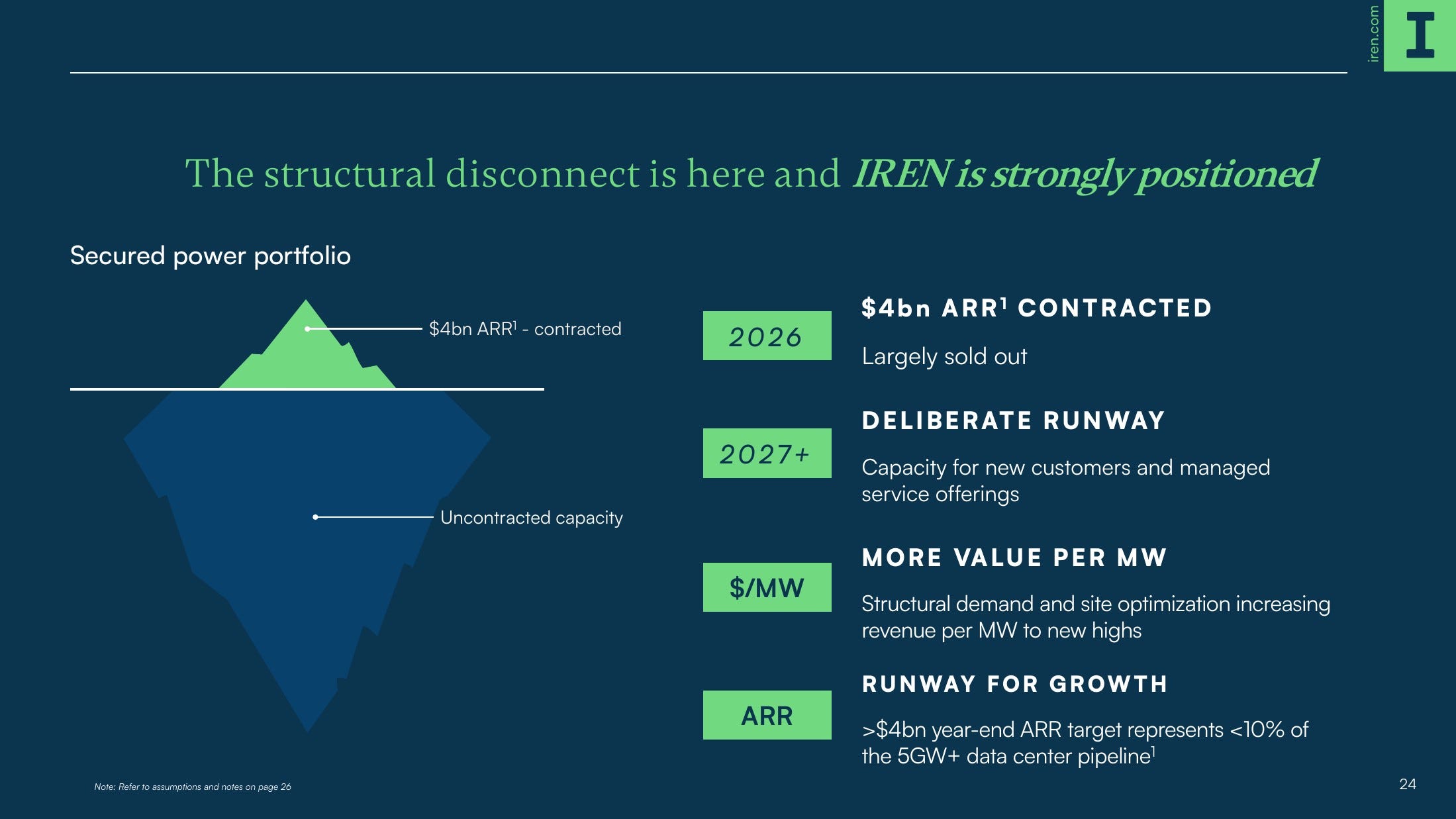
IREN recent three-year contracts are priced above $20 million per megawatt with active discussions near $25 million, but the contracted book sits well below that. Microsoft is $9.7 billion over five years against 200 MW of critical IT load, or $9.7 million per megawatt per year, and the $1 billion of ARR operating today runs near $10 million.
CoreWeave does not disclose its new contract values to investors. However, they did disclose that they raised prices 25% across teh board in July. And they are compleylty sold out. So we can understand that gimilir to NBIS, their older GPUs are sold out and prices have gone up. Overall, we can calculate a backlog of $104 billion against 3.7 GW of contracted power works out to $28 million per megawatt of total contract value. Roughly in line with what NBIS signed in the quarter.
Applied Digital is a landlord, renting out space for a fixed rate of about 1.7 million dollars per megawatt. Because they use long-term leases, they collect exactly what they sign for. Their lower price reflects the fact that they provide the building, not the computers.
Layers = Millions = Value
The difference between earning $40 million per megawatt and $1.7 million is a function of how many layers a company owns. Applied Digital sells two layers while Nebius sells six. The value can be seen clearly to exist in these upper Neocloud layers. For that reason, I’m going to drop Applied Digital from our conversation. Too much debt, too little to gain from an all consuming AI compute future. So let’s look to value the three remaining companies.
The valuation is hard to do as their multiples change rapidly. Over the past twelve months, CoreWeave’s market capitalization traded between $39 billion and $87 billion, while IREN ranged between $12 billion and $24 billion. Nebius moved 30% in a day after reporting Q2 earnings. The price to earnings are nonexistent to give us value, and we could use a price to sales, but that is also moving quickly. So while researching enterprise value for the valuation, one thing stood out: total debt.
IREN & NBIS show balanced balanced sheets. Both of their short-term cash and receivables is very close to their total debt. They’re both around 7- 8 billion.
CRWV has $51.4 billion across debt and leases, against $7 billion of cash with total liabilities over $72 billion. If compute prices stall or change direction or new GPUs come out and lower the price per token, basically if anything happens this company just so over leveraged that I have to eliminate it here.
Down to IREN and NBIS
Shares
We talked about the massive share issuance of IREN during its lasts 12 months, growing over 70%. In addition to that behind the current 380 million shares sit another 146 million potentially dilutive shares. up from 26.3 million a year earlier. This compares to NBIS’s 17.5% selective dilution, after a large run up in the stock.
Capital expenditure commitments
Comparing each company’s 2026 capital program to its enterprise value highlights the scale of funding required:
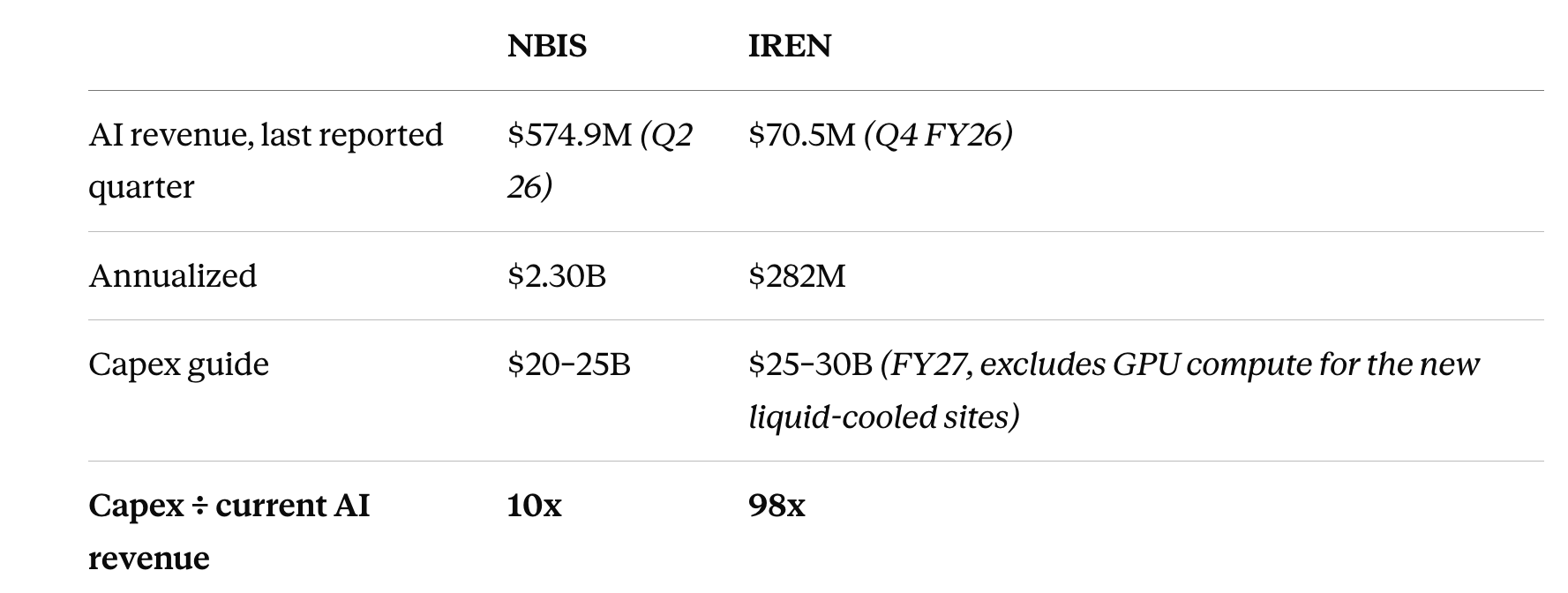
While both have plans to spend around 25B, one company has $582 million in AI revenue last quarter and the other has $70 million. NBIS has revenue growing each of the last four quarters and IREN’s has fell for that many quarters, wait actually five quarters.
Overall the capex guide for NBIS is 10x its current revenue rate, the real rate for actual earnings, not a planned future. IREN is planning to spend 98x its current income and is pointing you to look at the run rate they will achieve by year end. Or will they, in looking at their 10k (end of August 2026) I found this: Horizon 2-4 is targeted for delivery in phases in calendar Q4 2026, with grace periods under the Microsoft Agreement for delivery extending from mid-Q4 2026 to the beginning of Q2 2027.
IREN carries too much risk as it’s capex is 98x it’s current revenue rate and asks you to trust they will be earning $1 billion by the end of the year. It did say currently they are at a $1 billion run rate, so that would still be 25x to 30x their revenue, on spending. With possible construction delays, along with non stop share dilution makes me eliminate IREN.
Why I would buy Nebius
NBIS has capacity growing to end 2026 with about 800 and 1,000 active megawatts. From there, they plan to double again to roughly 2,000 active megawatts by the end of 2027. Contract values have roughly doubled from a $12 million MW to over $20 million. On top of that, they are also holding back some space and signing some short term contracts where buyers pay between $40 million and $50 million a megawatt. The margins are growing. The AI cloud adjusted EBITDA margin rose from 24% in December to 45% in March and 50% in June. Much of its funding comes from customer prepayments at zero percent interest. In a buildout where everyone is losing money on capital, the winner or survivor is whoever loses the least. In an industry where most players are burning massive cash or diluting shareholders to buy chips, Nebius is executing financially, operationally and is doing right by shareholders. I would recommend Nebius as the best of the four.