

Memory makers are often the highest beta trade in AI. The down days often leave memory stocks down double digit percentages. However, memory has been one of the best performing AI sectors. We did recently get a new memory ADR, SK hynix (SKHY), and it has been part of this volatile trade. The stock trades similar to other memory peers in that the forward P/E is low, 5.4 in the case of SKHY. Bears think memory is topping, and a pause in AI advancement could slow down memory. However AI inference trends all show a deep dependence on memory. Longer prompts, with expanding cache token sizes, will require more memory. TrendForce’s research indicates that modern AI chips will require two new additional layers of memory. SK hynix is positioned to benefit from the structural chip changes. As HBM reaches its limits, Enterprise SSD and HBF are additional layers of revenue for SKHY in the AI inference age. With its deep customer relationships and expanding product portfolio SK hynix is a buy today.
HBM built A Moat
SKHY is the market share leader in High Bandwidth Memory, which has been the story of 2025 and 2026, driving up profits at SK hynix and Micron. The customer base for Sk hynix has widened with HBM and has created a moat. With the HBM4 generation the base die moved to a TSMC logic process, where SKHY co-designed the base die with their end customers. Once a customer has engineered their chip around your base die, your memory orders are essentially locked in, as switching would mean redesigning everything. Sk hynix has co-design silicon with AWS, Google, Nvidia, Microsoft, Broadcom, and Meta. The valuable customers helped Sk hynix to surpass a $1 Billion valuation on the Korea exchange earlier this year. It however remained discounted to its memory peers due to its Korea primary listing. In an effort to expand its investor base and raise capital, the company issued a Nasdaq traded ADR. SHHY said the listing would expand its investor base, ultimately allowing its true corporate value to be properly evaluated. The listing comes at an interesting time as current memory products are insufficient for current long agentic workflows.
Two Memory Walls
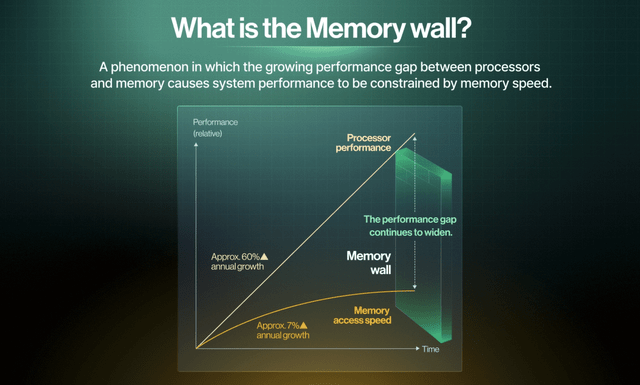
According to Gholami et al., “AI and Memory Wall,” IEEE Micro, over the past 20 years, peak server hardware floating-point operations per second have been scaling at 3.0× per two years, outpacing the growth of DRAM and interconnect bandwidth, which have only scaled at 1.6 and 1.4 times every two years, respectively. The data supplied by the memory, the bandwidth, cannot keep up with GPU speed, and this is what is called the “memory wall #1.”
HBM was the fix for the first memory wall. It moved the memory on package, and then expanded it by stacking. However, HBM has reached its scale capacity, as it would face yield drops if stacks were to be increased. Current HBM running temperatures are near their limits. Nvidia’s latest Vera Rubin model which carries up to 288GB of HBM, is insufficient for some 1 terabyte size current models.
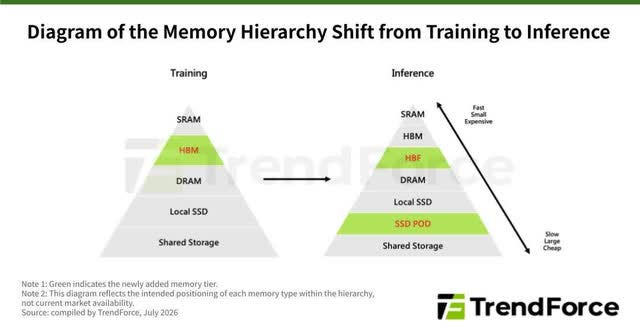
Now long context windows, and agentic multi-step reasoning all suffer from increasing Key-Value cache size. When you read KV cache think old chats (both your questions, and the AI response). Advanced models and their KV cache keep growing. HBM alone is increasingly insufficient to keep up with growing inference demand. More capacity is needed to hold new larger models, the KV cache, and allow agentic AI to run. All three of these utilize the HBM and together they have outgrown the capacity of HBM, which is “memory wall #2.” The solution is moving NAND up the stack and on package inside the AI chip. Enter two new flash tiers.
Shipping Now: SSD POD
In memory, it is the classic tradeoff triangle. Fast memory is expensive, and has lower capacity. High capacity memory is affordable, but it is slow. HBM read latency is about 15 to 30 nanoseconds while NAND flash takes between 20,000 to 100,000 nanoseconds. The AI inference market is a high transaction market with over 413 trillion tokens consumed daily. (I had to update the above number higher while writing, I wonder where it will be as you read this.) As token creation scales up, costs per token must decline along with them so the companies can remain profitable. Both speed and cost per token as well as function help to decide which memory type is used where. HBF and SSD POD have emerged as new layers in what is being called full stack memory. HBF is a next generation flash technology still under development. SSD POD is enterprise flash introduced by Nvidia earlier this year. It is basically a rack of SSDs dedicated to solve the KV cache bottleneck. SKHY is partners with Nvidia to supply the SSD. This new memory layer is already in production and can be seen in the Vera Rubin architecture, in the NVIDIA BlueField-4 STX The SSD POD Rack.
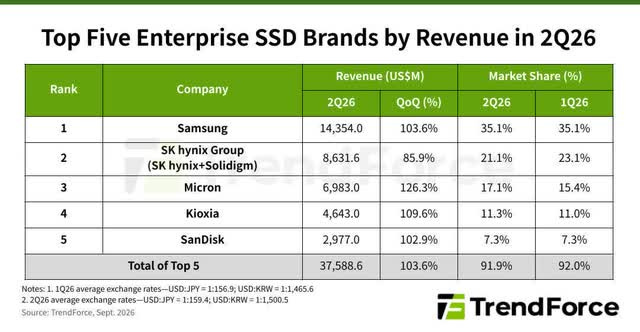
Trendforce reports that the enterprise SSD market for the top five companies, doubled, sequentially quarter over quarter. The SSD market saw both volume and higher contract prices. SK hynix is second by revenue in the SSD market, and in Q2 2026, they reported NAND ASP up mid-50% QoQ.
Coming soon - HBF
In 2025, SK hynix along with Sandisk formed a consortium to work on an open standard, high bandwidth flash, or HBF. Google and Tenstorrent joined the group as it releases its first technical specifications last month. HBF is exactly what you think it is, NAND stacked together, using the same packaging technology, on package, to create 8 to 16x the memory capacity of HBM.
HBF works alongside HBM, and won’t replace it. Flash has limited write cycles and is anywhere from 100 to 1,000x slower than HBM. Therefore HBM keeps the current working KV cache, while HBF could hold the static model weights, so its function is more read oriented. The model could be read from HBF without harming the write limited flash. The technology will offer a multiple of data storage for the same chip size. Bandwidth, the speed of data, is vastly improved as the stacked flash allows HBF to reach bandwidth levels that regular flash could not achieve. The specifications aims for a bandwidth of 1.6 TB/s for generation 1, slower than an HBM4 stack, but generation 2 & 3 are expected to equal and eventually surpass current HBM speed. Additionally, both capacity and bandwidth could grow, and a single HBF stack could offer terabyte scale capacity. Initial product samples are targeting 2027, with mass production coming in 2028.
Valuation
Before this summer, SKHY traded only on the Korean market and with less investor exposure the company traded at a lower valuation. The ADR has been here for two months, and it is trading at a premium to the Korean shares. As investors become aware of the stock, I believe its discount to Micron will disappear.
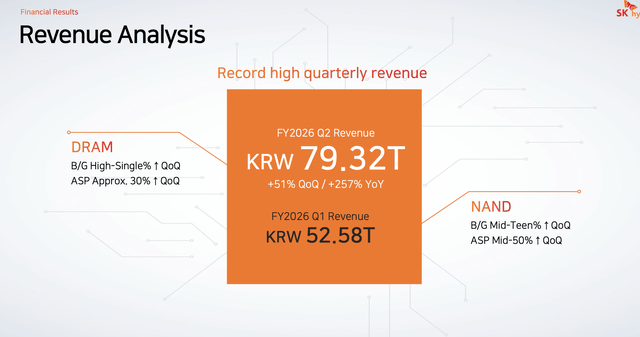
Memory valuation is inverted. When the p/e is low, investors believe the top is in. So with forward P/E at 5.4 and Micron at 6.26, investors believe the top is in, and earnings growth doesn’t continue. However, Q2 2026 saw DRAM ASP up 30% QoQ and NAND ASP up mid 50% QoQ. Those numbers come from a quarter with long term agreements. These agreements span multiple years. With supply sold out, and the supply tied to individual hyperscalers, it appears the financial strength continues.
Traditionally P/B is how memory companies were valued. It has ranged from 1x at bottoms and 5x at peaks, but now we have MU at 10.96 and SKHY at 7.68. Well above historical values. However, next year’s earnings are predicted at $34.03 a share, so $34.03 × 7.11Billion = $242 Billion in next year’s earnings. The current equity is $169 Billion , so next year’s earnings eclipse the entire equity on the balance sheet. Micron is similar. Current equity is $100 Billion, and has a forecast of $177 Billion in earnings.
After next year’s earnings then, SKHY P/B would be trading around 3x, MU trading around 4x Book value. Both within range and reasonable for the growth we are seeing.
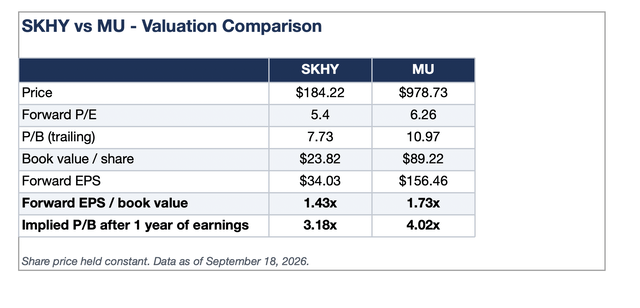
Current values don’t really reflect the change HBM had on memory companies, creating very high margins, consistent demand that outpaces supply and the actual profitability. With the market share in HBM and NAND, SKHY should not trade at a discount to MU. When you consider their HBM market position and the customer relationships, I think SKHY should trade at a premium to MU. SKHY trades at $184 today, and if it were to trade at Micron’s forward P/E of 6.26 it should be priced at $213. If it traded at a 10% premium that price would be $234. Wall Street’s average target is $253.91, a 38% discount to today’s price.
Risks to the thesis
SK hynix has been slowly losing share to Samsung and MU. (Insert photo) It is likely the trend will continue and will likely end with SK hynix holding less than 50% share, but holding some form of a duopoly with Samsung. UBS believes by 2027, Samsung will lead with an estimated 41% of HBM while SKHY falls to 39%. The share is decreasing in an ever increasing market.
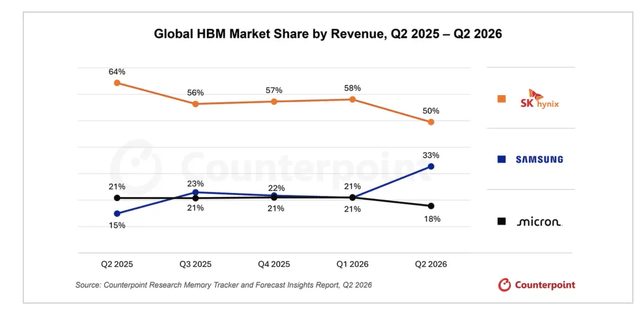
HBM market share by company Q2 2026 (Couterpoint)
Additionally, HBF has not received official adoption as the standard in future AI chips. Nvidia and AMD, the largest AI chipmakers, have not stated their future chips will use the HBF architecture. To address the growing capacity needs of modern AI many companies are actively building different solutions. The shape of the AI inference chip is still being developed and the final design to the memory capacity problem will have many solutions. However, we understand more memory is needed in all of its forms. With HBM, it was originally SK hynix that successfully developed the technology with AMD. SK hynix is behind the HBF and has teamed up with Google, Sandisk and Tenstorrent. The execution risk is tempered by its previous success.
Last, the stock is Korean based, and so the ADR carries Korean currency risk along with additional foreign government risk. There could also be foreign fees assessed by your brokerage.
Conclusion
OpenAI recently claimed to solve one of the Millennium Prize math problems, a group of seven of the hardest math problems that exist today. While the proof is still being verified the news release shows the promise of AI inference. In this case OpenAI is said to have used roughly 10,000 agents running together for about 88 hours. AI leaders additionally promote healthcare breakthroughs in the future. These advanced AI inference chips need large and fast memory to run continuously. The read, think, act loops all run through memory. As more memory layers are added to the next generation of chips, companies like SK hynix that sell both the DRAM and NAND will not reach peak anytime soon. With a conservative $234 target, anything below $200 is a buy.