

The Opening Pop
On Friday morning, at the end of the worst week for chip stocks in months, the biggest American listing ever completed by a foreign company listed at $149 and opened at $170. Demand ran seven times the shares available. Baillie Gifford, Coatue, and Leopold Aschenbrenner’s Situational Awareness fund anchored about $5 billion of it before the shares were even open for the rest of us.
I’ve been around new issues long enough to know better than to buy the opening pop. If you are old enough to remember the SpaceX IPO, you’ll remember the stock opened at $170, spiked to $225 within a day, and has already handed back the entire move. SpaceX loses about $5 billion a year and trades above 100 times sales.
SK hynix (SKHY) is the other trillion-dollar listing of the summer, and it is a completely different kind of stock. This is a company that makes lots of money right now, not a bet on an ideal future where electric cars and spaceships fill our roads and skies. Memory stocks, including Micron (MU), have seen net income explode along with their share prices over the past year, so a new ADR listing from the biggest AI-memory maker on Earth has my full attention.
The numbers that got my attention specifically: SK hynix earned about $64 billion in revenue last year at a 49% operating margin, and has since improved it to a massive 56%. Its profit margin was larger than Samsung Electronics, larger than MU, and makes it one of only three trillion-dollar companies with profit margins above 50% this year. Plus, it came to the Nasdaq priced between five and seven times this year’s expected earnings, depending on whose estimate you use.
(Korean won figures in this article are converted at the ₩1,523.5 per dollar rate the prospectus itself uses.)
A quick review before we go further. Last October I published the case for Micron on Seeking Alpha when it traded at $212 and the market still priced it like a commodity cyclical. The argument was that high-bandwidth memory (HBM), with its stacked memory design, had quietly transformed memory manufacturers into critical suppliers for the AI infrastructure. Micron closed Friday at $979—up about 360% since that article. I’m still long from $212, and I continue to hold. SK hynix is the same story but now is available to U.S. investors without setting up a Korean account or having to buy a Korean ETF with all of the other holdings.
What This Company Actually Is
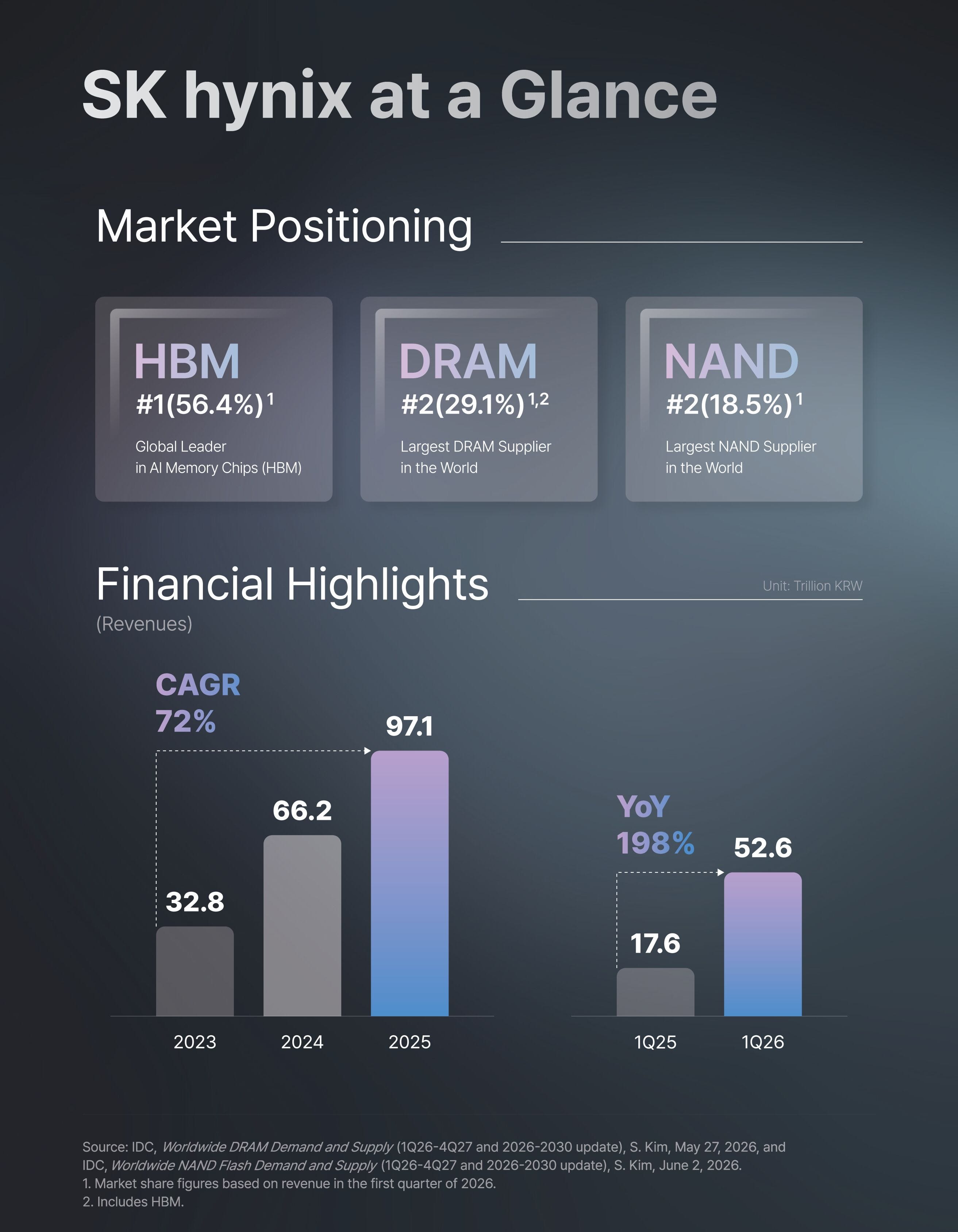
SK hynix is the world’s #1 supplier of HBM, the high-bandwidth memory stacked next to every Nvidia GPU, with 56.4% of that market by revenue in the first quarter, per IDC figures cited in the prospectus.
The broader story looks like this. In DRAM, they are the #2 maker globally at a 29.1% share. In NAND Flash, they are also the #2 maker at an 18.5% share, with their strength heavily concentrated in enterprise SSDs for data centers. Essentially, they sell the full memory stack: HBM for accelerators, DDR for servers, LPDDR for power-sensitive machines, GDDR for graphics, and eSSD storage.
Two structural points from the prospectus are worth passing along, because they’re the kind of thing that separates this business from the average performer.
First, the barriers to entry are incredibly high. Gartner projects total global semiconductor capital spending of $237 billion in 2026, with the top 20 spenders accounting for 87.6% of it. You cannot start a memory company anymore; the capital requirements are tens of billions a year.
Second, the customer base has fundamentally changed. Enterprise buyers, specifically data centers, now account for approximately half of all memory demand, according to IDC—up from about a quarter in 2020. Memory used to be brutally cyclical, but we know that’s not the case anymore. Hyperscaler capital spending is planned and funded years in advance.
Global Memory Semiconductor Market Size
(In billions of U.S. dollars)
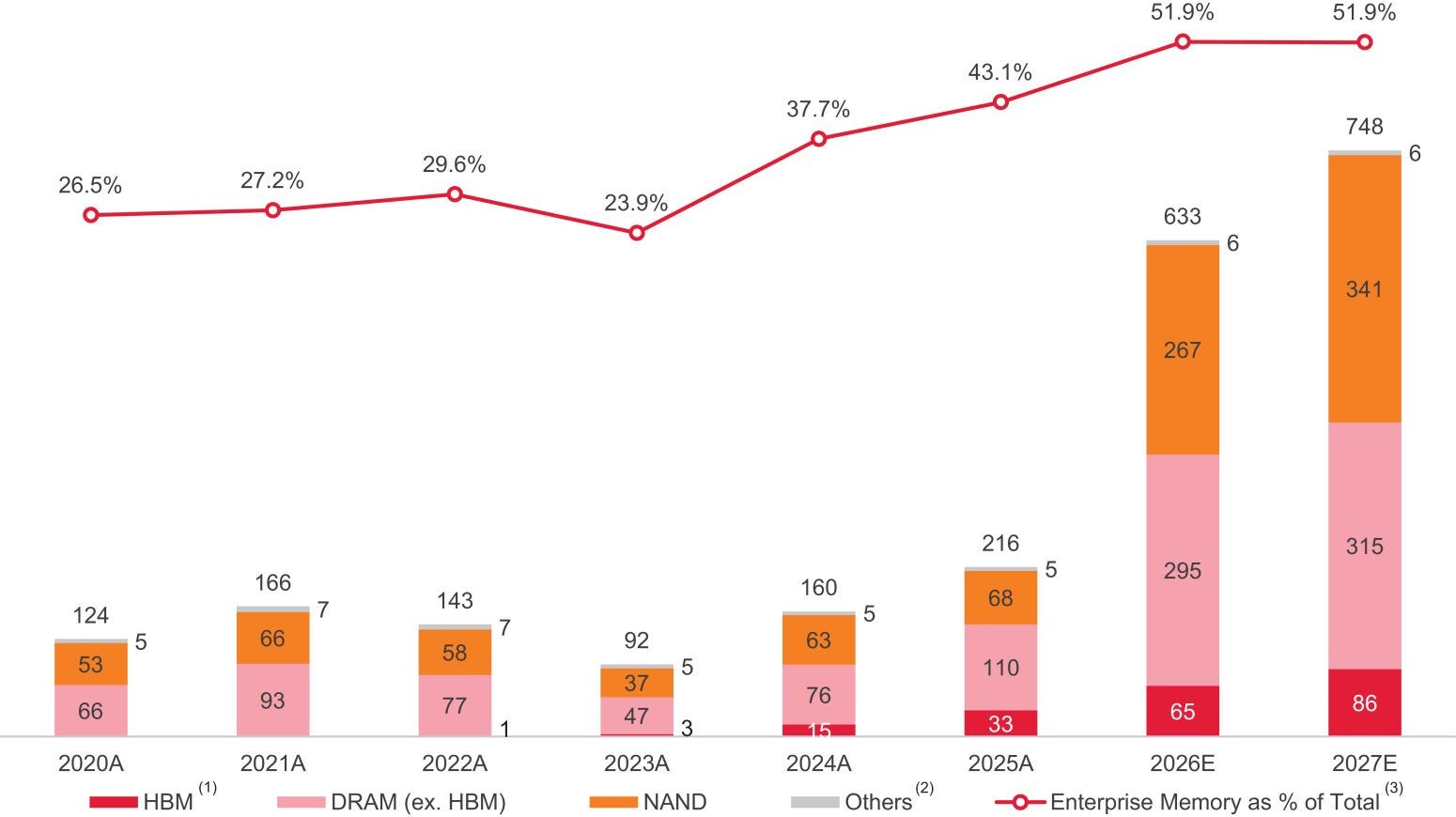
The prospectus indicates the memory market growing from $216 billion in 2025 to $633 billion in 2026 and $748 billion in 2027. If that seems like a lot, it’s actually all of the available memory on planet earth. All of it is all sold out, sorry if you wanted to buy a lot of memory.
SK hynix revenue went from $43 billion in 2024 to $64 billion in 2025, up nearly 50%, with HBM revenue more than doubling. Then the first quarter of 2026 showed $34.5 billion—up 198% from a year earlier. Micron’s numbers are similar; its May quarter came in at $41.5 billion, up 346%, and it guided the current quarter to roughly $50 billion. This is a three-player market where demand from a handful of hyperscalers has outrun the planet’s supply, and both listed pure plays are sold out into next year.
Having half of last year’s revenue in just one quarter this year makes me worry about the market’s sustainability. However, earlier this year Sanjay Mehrotra, MU CEO, said they signed guaranteed revenue through 2030 via long-term contracts, which was great news. Now with Kwak Noh-jung, SK hynix CEO, stating that “customer demand for AI memory chips will outstrip production capacity even beyond 2030”, the sustainability is confirmed to me. The most important thing to remember is the HBM architecture itself, in that every advancement uses more and more memory. The AI needs more and more memory to execute complex tasks, provide true utility with larger context windows, and build upon previous tasks.
How the Buildout is Being Paid For
With every AI name, you have to ask where the money for the plans comes from, because the answer lately is the bond market. The four big hyperscalers plan roughly $725 billion of combined capital spending this year, up 77% from last year’s record. Morgan Stanley expects AI-related debt issuance to approach $570 billion in 2026.
Alphabet has announced a significant $85 billion equity dilution to finance its AI data center expansion. Amazon has borrowed roughly $64 billion across offerings this year, set records in the Canadian and European bond markets doing it, and still opened a $17.5 billion credit line. Even Nvidia sold $25 billion of bonds in June.
SK hynix funded its expansion with this new ADR. It generated about $28 billion net, with demand seven times the offering, diluting existing holders by about 2.5%—and it barely needed to do that. The business generated $35 billion in operating cash flow last year against $18 billion of capital spending. The first quarter alone produced $17.3 billion in operating cash against $5 billion of capex.
The proceeds have a specific job: roughly $30 billion for new Korean fabs including the first Yongin cluster plant, $7.8 billion of EUV lithography tools through 2030 (ASML anyone?), and a $12.5 billion advanced packaging plant breaking ground next spring, along with packaging capacity in Indiana. Notice what’s not on that list: China. Every dollar of growth capital lands in Korea or the United States, which matters for the risk section below.
Profitability: Numbers Memory Has Never Printed
The first quarter’s gross margin was 79.3%. The operating margin was around 72%. Return on equity runs above 60%, on a balance sheet with almost no debt and about $14 billion in cash.
For reference, Micron recently reported gross margins exceeding 80%. This unprecedented economic performance by two competitors indicates a structural scarcity issue, not some great management team. It also brings to mind my second question that matters for the investment: Do margins like this continue? Are memory margins permanently changed?
Valuation: MU as a Comparison
On earnings, the stock is startlingly cheap. It sits between five and seven times 2026 earnings, representing a PEG ratio of 0.07. The trailing earnings multiple is around 21. Thirty-five of the thirty-seven analysts covering the Seoul shares rate it a buy, with an average target about 45% above the recent close. Micron, after its own re-rate, trades near 13 times forward earnings. Again, SK hynix is at a 6-7 forward P/E and Micron is 13. Closing this gap is probably what this Nasdaq listing exists to do.
On book value, the picture changes. Memory investors spent thirty years valuing these companies on price-to-book, because at every cycle turn the earnings evaporated and book value was all you could trust. (Who’s old enough to remember MU stuck at $40 for years?) SK hynix trades near nine times trailing book, maybe five times year-end 2026 book if the consensus profit shows up. That is much higher than the historical 3-4x in the best of prior cycles. Even the bullish Korean brokerage notes justifying higher targets lean on the observation that a broad consensus has formed on the durability of this upcycle.
So the P/E on this debut still shows the market pricing SK hynix as a cyclical that will eventually give the earnings back. The P/B is higher than ever on a historical basis. Which market view of the stock wins depends on whether long-term contracts have genuinely broken the memory cycle. Micron has signed 16 multi-year agreements with binding commitments it values at $22 billion, and the market rerated it. SK hynix has its entire 2026 sold.
Momentum: A Debut with a Calendar Attached
The stock in Seoul is up about 675% over the past year. It set a record high in late June, then pulled back roughly 25% into this month’s chip selloff—the same selloff that knocked Micron 22% off its high in two weeks. SK hynix listed directly into that weakness and still opened 14% above pricing. New issues that enter in that environment and hold the bid are telling you something about demand.
This debut has a lot going on in the next few months. On July 13, regular trading under the permanent ticker SKHY begins (the temporary SKHYV symbol retires) the same day a pair of leveraged ETFs on the name launches. Then, second-quarter earnings land on July 23, just ten days into the stock’s U.S. life. On July 29, the newly issued shares list on the Korea Exchange. Looking further out, early October brings the lock-up expiration on the company and its affiliates—an unusually short 90 days that is worth a calendar entry, since that’s when additional supply could legally hit the market. Finally, December brings eligibility for Nasdaq-100 inclusion, the kind of mechanical index demand that doesn’t read anyone’s cycle views.
Revisions: The Estimates Can’t Keep Up
This is quietly the strongest factor and the one that made me act rather than just watch. The analyst revision log on the Korean shares reads like a ratchet: 2026 earnings estimates lifted from around ₩200,000 per share to ₩281,000 in successive rounds, full-year revenue forecasts raised from $162 billion to $209 billion, price targets that roughly quadrupled in months.
One major Korean broker raised its target 43% in a single note this spring, and the stock ran through the new number anyway, and then they raised it again. (Korean analysts are just as useful as American ones, good to know). When a business beats, guides higher, and forces the models up quarter after quarter, that revision pressure is the mechanical engine of a re-rate.
What Can Break It
Three things can trip this up, in order of how much they’d hurt.
China is the structural one. About 40% of SK hynix’s DRAM output comes from its fab in Wuxi, and roughly a quarter of its NAND from the Dalian plant it bought from Intel. Washington revoked the blanket equipment waivers for those plants effective the end of last year and replaced them with annual licenses that allow operation and maintenance but explicitly no capacity expansion or technology upgrades. The Wuxi fab is effectively frozen at older process nodes, and every December is now a renewal event that a trade dispute could complicate.
The most effective mitigation measure is the one mentioned in the funding section: the HBM lines, the transition to leading-edge DRAM, and all the new capital expenditures are located in Korea and Indiana. The frozen assets represent the legacy infrastructure, not the growth engine. However, a license denial would still significantly reduce output and necessitate the costly replacement of capacity years before the planned schedule.
Global HBM Market Shares by Revenue
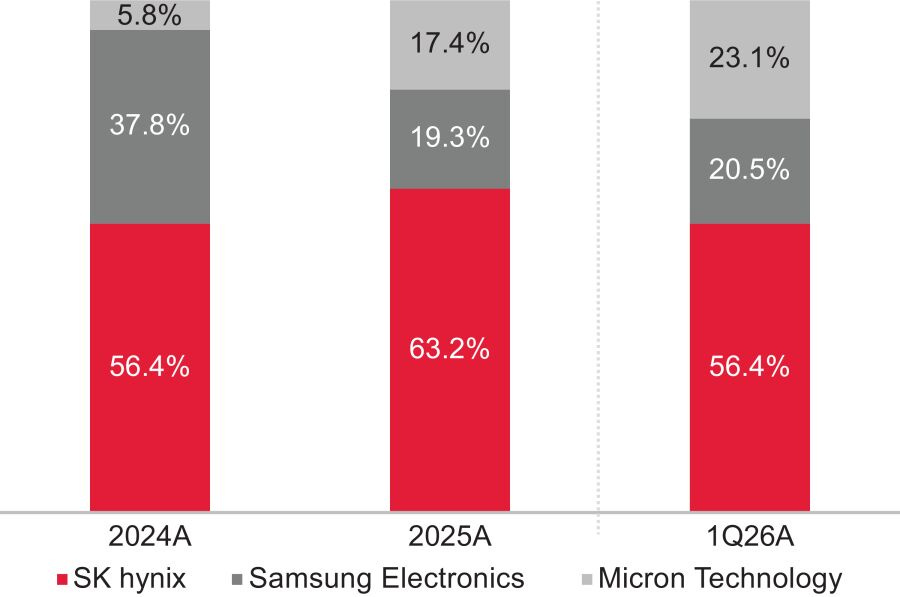
Competition is the live one, and the prospectus includes a chart I’d frame if I were bearish. SK hynix’s share of HBM revenue was 63.2% in 2025. In the first quarter of 2026 it was 56.4%. In the same stretch, Micron went from 17.4% to 23.1%, passing Samsung to become the #2 HBM supplier in the world, while Samsung stabilized around 20% and won a fifth of Nvidia’s next-generation orders plus the lead slot on AMD’s new accelerator.
SK hynix still holds an estimated 70% of Nvidia’s HBM4 allocation, and Nvidia was 14.8% of its total revenue last quarter, with a second customer crossing 10% for the first time. But the direction of the share chart is not in dispute; the bull case only requires that the erosion stay slow while the pie grows fast. That chart, more than anything else, is why my position size looks the way it does.
The cycle is the existential one, and while I believe sales are changed with the technology, I don’t know about the margins. No memory company has ever sustained a 70% operating margin. The whole debate—the P/E lens against the P/B lens—compresses into whether contracted, allocated, multi-year AI memory demand behaves differently from every boom in this industry’s boom-and-bust history. My framework doesn’t require me to answer that with confidence. It requires me to size the position as if I might be wrong.
What I Actually Did
Ultimately, we have a super high-margin business that hasn’t yet fully reached a price that reflects its current business. I did buy it. But my overall prospectus reading left me feeling like I wanted to buy, but not sell MU or anything crazy, just to purchase more.
Every stock I own must pass two hurdles. The first is my extensive framework. I won’t go over all of it today, but I ask a long list of questions, such as if Google, Amazon, Microsoft, or Meta decided tomorrow that it wanted to enter this market, does this company still win? Is this company headquartered in, or critically dependent on, high-risk jurisdictions? Are they an indispensable architectural bottleneck, that grows as the technology grows? SK hynix did pass all of my questions and is probably a close second to Nvidia as a reliable supplier in AI infrastructure. The second gate is independent confirmation from a quant system, which grades valuation, growth, profitability, momentum, and revisions without caring about my narrative. Micron sits at Strong Buy there.
SK hynix has no Quant rating at all. It can’t, it’s too new. My quant gate exists for a great reason because I have bought an lost a lot on great stocks that only passed my own screener. This second gate exists precisely for moments like this: when the story is this good, and the temptation to skip the process is strongest.
So I own a starter position in SKHY, and it earns its way to full size as the confirmations arrive: the July 23 earnings date, the first full quarter of regular trading, Quant coverage initiating, and December’s index decision. Micron remains my anchor in the space, long from $212, and I feel great about my MU after seeing the SK hynix prospectus.
Disclosure: I am long MU and SKHY. Everything here describes my personal portfolio and process. It is informational only — not individualized investment advice. Do your own research.